Collaborative Care Across the Advanced Cancer Continuum
March 20th, 2026 | 8:30am to 3:30pm Hyatt Regency, New Brunswick, NJ 08901
Join Crossroads4Hope and leading voices in oncology care for a powerful one- day professional development conference focused on some of the most critical and compassionate aspects of cancer support.
Eligible participants can earn Continuing Education credits in Public Health, Social Work, Professional Counseling, Nursing, and Psychology. Scroll down for more information.
Gain expert led knowledge on best practices and therapeutic approaches for delivering comprehensive support for individuals and families impacted by advanced cancer.
Whether you’re a healthcare provider, community leader, mental health professional, or part of a care team, this is your opportunity to deepen your impact,grow your expertise, and connect with a community committed to whole-person care.
Together, we’ll elevate the standard of support - when it matters most.
Introducing Our 2026 Keynote Speaker:
Yaron A. Moshel, MD, PhD, FAANS
The Human Side of Neuro-Oncology: Compassion, Communication, and Collaborative Support in Brain Tumor Care
Navigating a brain tumor diagnosis often requires patients, families, and clinicians to make complex medical and emotional decisions under extraordinary stress. In this session, Dr. Yaron Moshel will discuss communication strategies that foster trust, resilience, and dignity throughout the neuro-oncology care continuum — from initial diagnosis to treatment planning, survivorship, and end-of-life considerations.
Drawing on real patient experiences, Dr. Moshel will highlight techniques for delivering difficult news, facilitating shared decision-making, and ensuring patients and families understand their options in a clear, compassionate, and culturally sensitive manner. The presentation will also emphasize the essential role of the multidisciplinary support team — including oncology nurses, social workers, counselors, rehabilitation specialists, and community-based organizations like Crossroads4Hope — in helping patients cope with uncertainty, maintain quality of life, and navigate transitions.
Participants will leave with practical frameworks for high-stakes conversations, strategies for managing emotional responses, and tools to support caregivers as part of the extended care unit.
An advanced cancer diagnosis can have a huge physical and emotional impact on both a person diagnosed and their loved ones. This workshop discusses cancer rates and prevalence and the emotional impact an advanced cancer diagnosis can have on a person and family, including any children involved. Tips, techniques, and resources to support a whole family through a diagnosis will be discussed.
Breakout Sessions
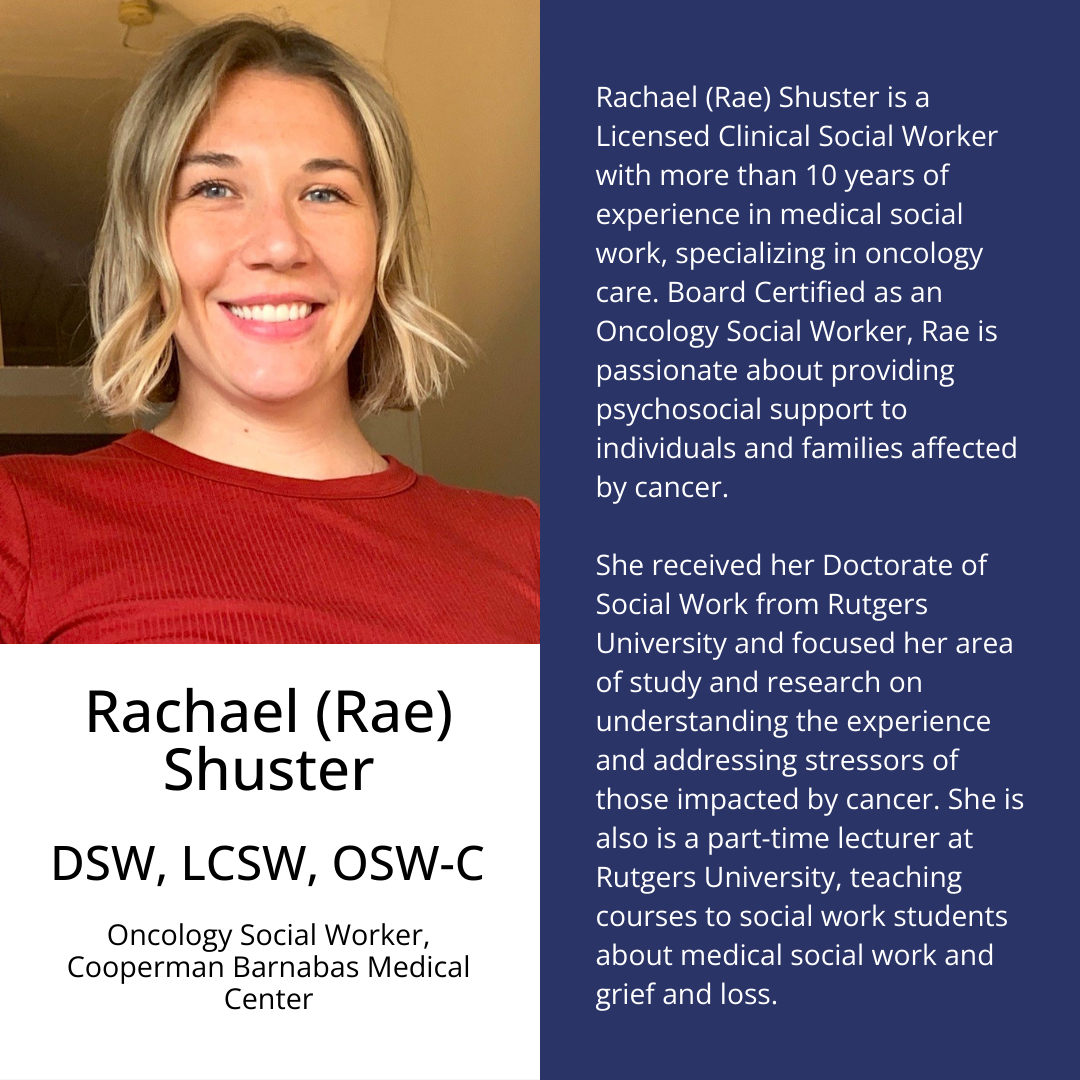
During registration, each participant may select one of the three courses offered in Breakout Session One and one of the three courses offered in Breakout Session Two. To view presenter biographies, please click on each presenter’s button.
Breakout Session One
Breakout Session Two
Making the Uncomfortable (More) Comfortable: Normalizing Conversations on Death and Dying
This interactive workshop will begin with definitions of loss, grief and mourning and then will explore the reasons why we are uncomfortable talking about death and dying. Participants will learn about how and when to initiate conversations about end of life, and practice exploring their own values when it comes to this transition. They will learn specific tools for companioning someone who is living through a loss, whether that be a new illness or diagnosis, anticipatory grief or death.
The Value of Choice at the End of Life: An Exploration of Medical Aid in Dying
This session will introduce Medical Aid in Dying (MAiD), explaining the law in NJ, an overview of an active program providing this service, the barriers to access and what patients and loved ones can expect. This will be followed by a testimonial from a loved one whose partner chose to use MAiD at the end of her illness. A question-and-answer period will be provided at the end of the talk.
Continuing the Journey: Supporting Pediatric Patients Through Progression and Recurrence
This presentation offers an essential look at the emotional, cognitive, and social well-being of pediatric cancer patients facing disease progression or recurrence, centering on the integration of psychosocial and developmental expertise with palliative care modalities. Our focus is on providing developmentally-informed communication, detailing techniques for explaining relapse and the shifting goals of care to children across different age groups—from toddler to adolescent—to ensure understanding, minimize fear, and encourage self-expression. We will explore the practical application of interventions to manage non-physical symptoms, including anxiety, distress, isolation, and anticipatory grief, and demonstrate the use of expressive therapies and legacy building as core supportive strategies. Furthermore, the session addresses the crucial task of supporting siblings and parents through the emotional impact of recurrence, helping them maintain a sense of family normalcy, and fostering team collaboration to keep the child’s voice and developmental needs central to the care plan. Crucially, this session addresses the often-overlooked necessity of supporting the care team itself when recurrence or progression occurs, providing strategies for team debriefing, resilience, and emotional wellness to sustain compassionate care.
Pain is one of the most common issues facing cancer survivors. The causes of pain in this group is often complex and interconnected. Pre-existing issues such as arthritis and other degenerative disorders, nerve issues, depression, anxiety and other problems often worsen as a result of cancer and its treatment. Much of the pain seen in cancer survivors is not due to the cancer itself, but the various toxic treatments such as surgery, systemic therapy and radiation therapy used to control it. This presentation will discuss the pathophysiology, evaluation, and comprehensive management of pain in cancer survivors.
Caring Beyond the Cure: How Support Professionals Can Improve Quality of Life for People with Cancer
Interdisciplinary care and support professionals, including social
service providers, community health workers, case managers, nurse
navigators, educators, and patient advocates, play a vital role in
helping patients with cancer and their families live well throughout
serious illness. This session will explore how palliative care, a
specialized approach focused on relieving symptoms, stress, and
suffering, enhances quality of life for patients, caregivers, and families.
Participants will gain a clear understanding of how palliative care
differs from hospice, when and how it can be introduced, and why it is
essential at any stage of serious illness. The session will also highlight
New Jersey’s forthcoming Medicaid Community-Based Palliative Care
benefit, launching in 2026, and the crucial role these professionals will
play in promoting equitable access and continuity of care. Through
real-world examples and actionable strategies, attendees will learn
how to recognize when patients could benefit from palliative care,
initiate supportive conversations, and collaborate across disciplines to
ensure that care aligns with each person’s values, goals, and quality-of-life priorities.
This workshop provides practical guidelines for conducting life review and legacy work with patients and families. It explores the practice of deep listening, which includes the art of asking fruitful, open-ended questions.
Sponsored by (Crossroads4Hope), a designated provider of continuing education contact hours (CECH) in health education by the National Commission for Health Education Credentialing, Inc. This program is designated for Certified Health Education Specialists (CHES®) and/or Master Certified Health Education Specialists (MCHES®) to receive up to 3.5 total Category I continuing education contact hours.
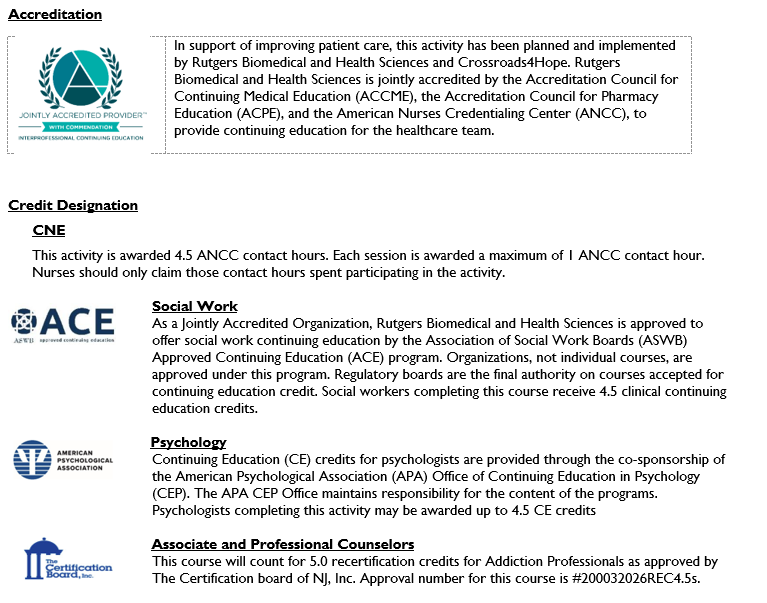
Eligible participants can earn Continuing Education credits in Social Work, Professional Counseling, Nursing, and Psychology. This activity has been jointly planned and implemented by Rutgers Biomedical and Health Sciences and Crossroads4Hope. For questions, please contact cce@ubhc.rutgers.edu.
Sign up to receive important updates on our programs, events, and resources designed to support those affected by cancer. Be the first to know about our initiatives, community stories, and opportunities to get involved. Together, we can make a difference!